
Halifax County Release Meaning
A Halifax County release closes one episode of custody, but it does not always mean the person walked into the community. The Halifax County Adult Detention Center is part of the Blue Ridge Regional Jail Authority, or BRRJA. Its current inmate inquiry is meant to locate people who remain in that regional system. Once a person no longer appears, the next fact must come from a stored release or transfer entry. The Halifax County Sheriff may hold an arrest, transport, warrant, or incident record, while BRRJA normally holds the jail booking and release record. The court keeps the case and its orders.
Halifax Correctional Unit is different. It is a Virginia Department of Corrections facility for state-responsible people, not the county booking jail. A person discharged from that unit has left VADOC facility custody. A person paroled from it has left the prison but remains under supervision. Someone moved to another prison is still confined. The agency, facility, and destination must therefore be named before a Halifax County release can be understood.
Halifax County Release Types
Local jail custody may end because a court grants bond, releases a person on recognizance, dismisses a charge, credits time served, or records completion of a local sentence. Some exits are transfers. A VADOC commitment, move to another regional jail, hospital trip under guard, federal pickup, or immigration detainer continues custody elsewhere. The release category and destination are as important as the time of departure.
| Custody event | Meaning | Best next record |
|---|---|---|
| Bond or recognizance | Physical jail detention ends while the case may continue. | BRRJA release entry and court bond order |
| Time served or sentence completion | The confinement in that matter ends, subject to other holds. | Release entry and sentencing disposition |
| Parole | Prison confinement ends, but state supervision continues. | VADOC locator, release documents, and supervision district |
| Discharge | The identified VADOC term ends, though other duties may remain. | VADOC release letter and inactive record |
| Transfer or detainer | One facility episode closes while custody continues elsewhere. | Recorded destination and receiving-custodian search |
“Dismissed” describes a court result, not the moment staff opened the jail door. “Deceased” can also close a custody record, but it must never be presented as an ordinary release. When two or more cases exist, a favorable result in one does not clear a hold in another. The safest finding pairs the custody entry with the controlling order and the next known status.
Note: A transfer closes one facility episode while custody continues, so the recorded destination is essential to the release finding.
Halifax County Release Record Fields
There is no single Halifax County release certificate used for every custodian. A BRRJA jail-management entry may contain the items below, but BRRJA has not published a field dictionary. Ask for each field instead of promising that it exists in every record. A VADOC release packet has a different purpose and may include a notification-of-release letter plus an order or conditions for parole or probation.
| Field to request | What it can show |
|---|---|
| Booking identifier | Links the release to the correct jail episode. |
| Identity fields | Helps distinguish people with similar names. |
| Booking date and time | Shows when the custody episode began. |
| Holding authority or charge | Identifies why the facility held the person. |
| Release or transfer date and time | Records when the facility episode ended. |
| Release category or authority | May identify bond, court order, time served, discharge, or transfer. |
| Destination custodian | Can separate community release from continued custody. |
A court record can add the disposition, sentence, suspended time, probation term, appeal, or later revocation. It may explain the legal basis for release without stating the physical exit minute. VINELink supplies a timely event from a participating jail, but it is not an archival release record. VADOC’s locator can show state custody or supervision, yet it should not replace BRRJA records for a person whose custody never became a state sentence.
Request Halifax County Release Records
Send a Halifax County Adult Detention Center custody request to BRRJA’s FOIA office. Its form accepts a first name, last name, phone, email, and comments. A narrow request should identify the person, HCADC, the known booking number if available, and an exact date range. Ask for the existing booking and release entry, release or transfer time, release authority, destination, and booking photograph as separate record items. Electronic delivery and an advance cost estimate can reduce uncertainty.
- Confirm that HCADC or BRRJA was the custodian, not Halifax Correctional Unit.
- State the person’s full name, known identifier, facility, and a focused date range.
- Name the existing fields or documents wanted, including release category and destination.
- Ask for an electronic copy and an itemized estimate before costs exceed a chosen limit.
- Compare the response with the court order and any later custody or supervision record.
510 Ninth Street
Lynchburg, VA 24504
434-847-3100 ext. 1224
foiarequest@brrja.state.va.us
Virginia FOIA generally calls for production or a statutory written response within five working days. The public body may invoke added time when the law permits. Fees must reflect reasonable actual cost, and no fixed BRRJA copy fee was found. A public body need not create a new spreadsheet that does not exist. Request an existing log or entry and ask whether a useful export is already maintained.
Use the Halifax County FOIA route for records made by the Sheriff, such as an arrest or transport record. Use VADOC’s records route for a state term. Court orders come from the correct clerk, not through a routine executive-agency FOIA request. This division keeps each request with the office that made the record.
Note: BRRJA may redact exempt information or report that a requested field or record does not exist.
Halifax County Release Record Law
Virginia Code § 2.2-3704 sets the general public-record request process for Virginia citizens and qualifying media representatives. The law allows access subject to specific exemptions, permits actual-cost charges, and does not force an agency to create a record. Virginia Code § 53.1-116 requires a jailer to keep commitment and prisoner records and a written earned-credit policy. That duty supports a focused request, but it does not make every field open without review.
Law-enforcement records, jail records, supervision files, and court files do not all follow the same access rule. Juvenile material, security-sensitive facts, victim information, criminal investigative files, and sealed records may be restricted. An agency that withholds material should identify the record category and statutory basis. Nonexempt parts may still be released after redaction.
Virginia expungement and sealing rules can remove a case from public view. The law is changing in 2026, including a major transition scheduled for December 1, so the effective provision must be checked when the request is made. A missing public case can be the intended result of law. It does not prove that no custody event ever occurred.
Halifax Court Release Proof
The Halifax court path splits between General District Court and Circuit Court. General District Court commonly holds misdemeanor dispositions, bond events, traffic matters, and preliminary felony proceedings. Circuit Court holds felony judgments, appeals from district court, and local expungement proceedings. Follow the case number and court name instead of assuming every HCADC release belongs in Circuit Court.
The Virginia Judicial System case portal can show the charge, hearings, disposition, sentence, suspended time, probation, and later revocation activity. A final order is stronger than a docket summary for the legal outcome. Neither one normally certifies the exact minute of physical release. For a certified order or an older matter, ask the clerk for the final disposition, sentencing order, bond order, or revocation order by case number.
The official Halifax General District Court page is the source for current clerk details. Its interface is pictured below because it helps distinguish the local court record from the jail’s custody entry.
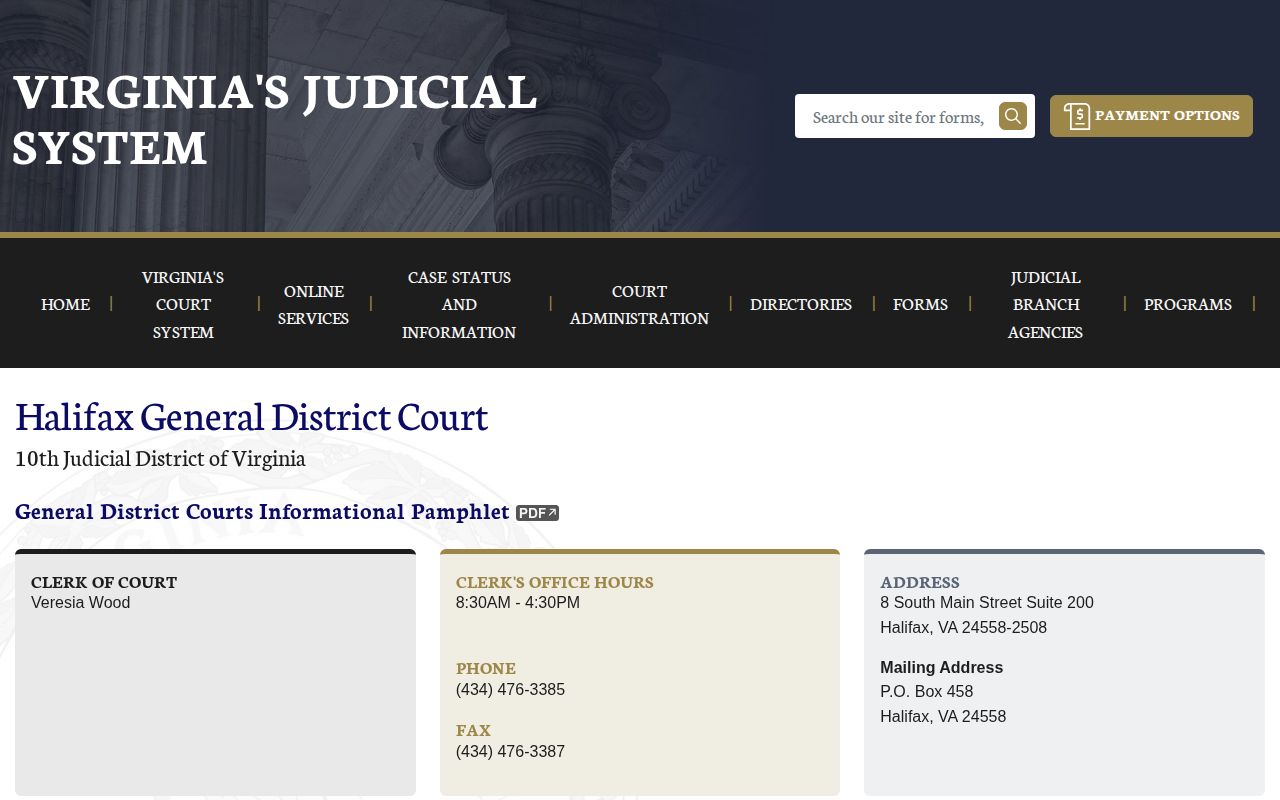
A Halifax court result explains authority for release. BRRJA remains the source for the physical jail exit or transfer entry.
Note: Match the case number as well as the name because one person can have matters pending in more than one court.
Find Halifax County Released Inmates
Begin with the custody class. A Halifax arrest or short local sentence points first to HCADC and BRRJA. A state sentence or known placement at Halifax Correctional Unit points to VADOC. A federal result requires the BOP or federal court route. Immigration transfer calls for ICE. Searching the wrong system is the main cause of false no-results.
- Check the BRRJA Halifax inquiry for present regional-jail custody. Treat absence only as a cue to continue.
- Search Virginia Jail VINE for a specific local custody event, then match the agency and identity.
- Review the correct Halifax court case for the bond, dismissal, sentence, or transfer authority.
- Use the VADOC locator when a state sentence, prison placement, or state supervision is possible.
- Check BOP or ICE only when the record suggests federal or immigration custody.
- Request the stored release or transfer entry when public interfaces do not settle the question.
The absence of an official local feed means a same-day list must be obtained through BRRJA’s records fallback. For one named person, a date-bounded request is often more precise than a broad list request.
VADOC Halifax Release Search
The official VADOC Inmate and Supervisee Locator covers people in Department custody and people under Department supervision. That scope matters in Halifax. A person can leave Halifax Correctional Unit and appear at a probation and parole district because prison custody ended while legal supervision continued. The locator is not a complete archive for every person who was finally discharged.
| Search field | How it works | Use |
|---|---|---|
| First name | Enter at least the first three letters with a full last name. | Broad name search |
| Last name | Use the complete legal surname. | Required for name route |
| Seven-digit DOC ID | Searches the assigned VADOC identifier. | Most precise route when known |
| Location, race, gender, age | Available filters can narrow similar names. | Identity check, not proof by itself |
Open the record and copy the date label exactly as shown. VADOC public material refers to a release date, while victim-notification material uses anticipated release date. A later order, credit change, discipline event, detainer, or recalculation can change that date. If an older discharged person is missing, use VADOC records, the release letter, and the committing court rather than assuming the term ended on a guessed date.
The official VADOC search form shown here is the right state route for Halifax Correctional Unit releases.
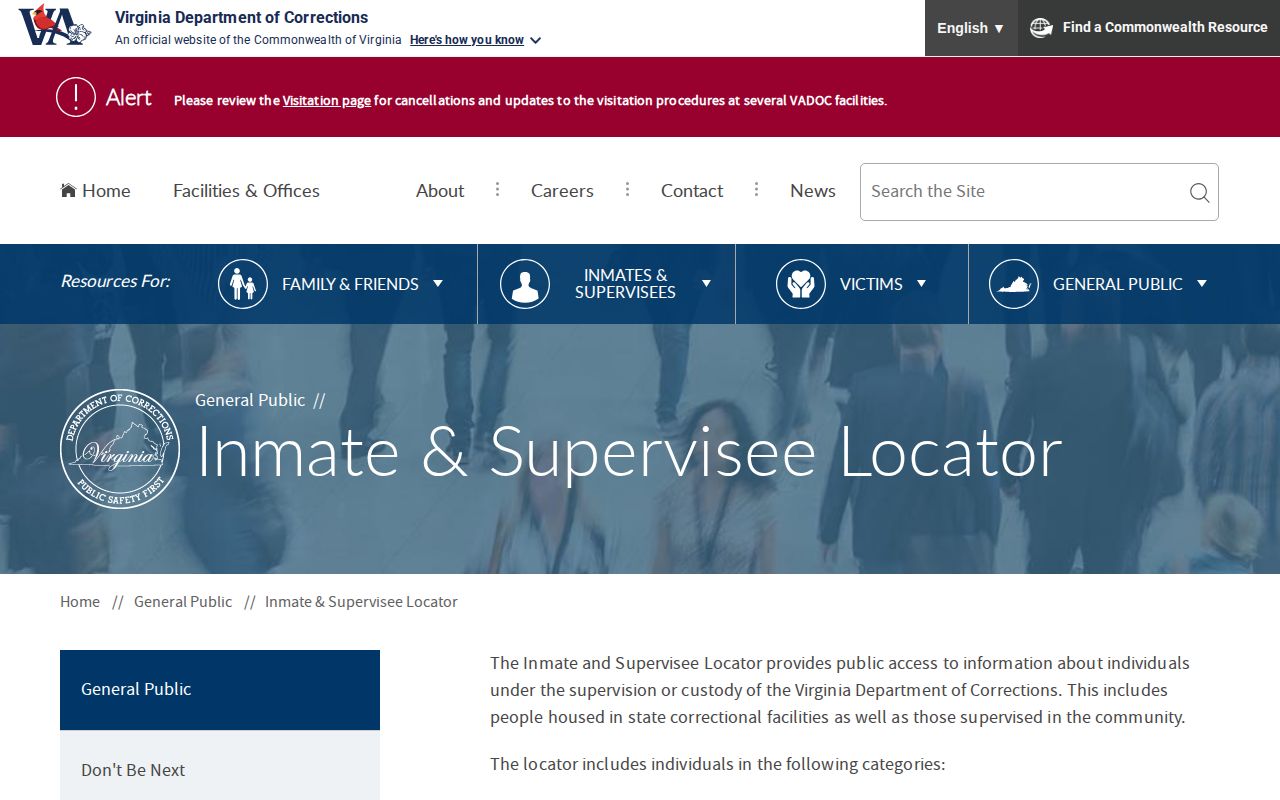
Its results must be read with the facility, supervision status, and exact date label together.
Halifax Recent Release Gaps
No official Halifax County, Virginia 24-hour or 72-hour release feed was verified. BRRJA labels its vendor link “Locate HCADC Inmates,” which describes current custody. No official released-person retention window, list cadence, release fields, or photo policy was found for that public inquiry. A name that drops off the tool could have been released, transferred, omitted, or delayed in processing.
A recent-release request should define the exact start and end timestamps and identify the Eastern time zone. Ask whether BRRJA maintains an existing release log or export for that interval. Request the release time and category, but do not demand a new analysis. A broad three-day request may cost more than a request for one person because Virginia FOIA permits reasonable actual-cost charges.
No official BRRJA or Halifax County Sheriff mobile app offering release lists or mugshots was located. Avoid the similarly named Halifax County, North Carolina tool. It belongs to another state and agency. Virginia Jail VINE, the court docket, HCADC operational confirmation, and a BRRJA record request are the verified local fallback chain.
Note: Define recent-release request windows with exact dates, times, and the Eastern time zone to reduce ambiguity.
Halifax Release Alert Systems
Virginia uses two notification layers. Virginia Jail VINE through VINELink receives events from participating local jails. Search one person, confirm that the reporting agency is BRRJA or HCADC, open the right record, and register for the offered event. A release alert reports the source agency’s custody update. A transfer event or later detainer can mean the person remains confined elsewhere.
VADOC directs state-custody notification registration to NAAVI. Local VINE registration does not carry into NAAVI when a person transfers to state custody. VADOC can provide transfer, anticipated-release, changed-date, and actual-release notices to eligible registrants, then stops after release. The systems are consecutive, not interchangeable.
The official Virginia VINELink screen below shows the local-jail starting point.

A notification should be paired with the BRRJA entry or VADOC release record when historical proof is needed.
For a federal sentence, the BOP Inmate Locator can show “Released” and a recorded date for many federal records from 1982 forward. “Not in BOP custody” does not prove community release because USMS, state, immigration, contract, or supervision status may follow. The ICE locator is a current-custody tool, not a Halifax release archive. No federal prison or dedicated ICE detention center was found in Halifax County.
Halifax Release Documents and Property
VADOC facility release staff provide unusually detailed exit steps for people leaving a state facility such as Halifax Correctional Unit. Staff review the applicable Order of Release, Conditions of Probation, or Conditions of Parole. The released person and a witness sign and date the document. Personal property is returned, state-issued prison clothing is collected, and clothing may be supplied when needed.
The business office returns the offender-pay balance. Unless a detainer applies, VADOC adds enough to reach $25 when the balance is lower. Later-posted funds are forwarded within five business days. Medical staff may supply up to 30 days of discharge medicine and needed supplies. A timely request for medical records can also result in a copy near release. Virginia Code § 53.1-31.4 addresses identity documents for qualifying prisoners held at least 90 days.
These are state-prison policies. They are not proven HCADC practices. BRRJA did not publish an equivalent Halifax regional-jail release property or transport procedure in the researched sources. Confirm operational needs with the actual custodian and do not transfer VADOC rules to a regional jail.
Post-release supervision is a separate status. State parole, state probation, local community corrections, and pretrial supervision each use a different office and legal basis.
Halifax Facility Release Differences
Two Halifax facilities create a naming trap. Halifax County Adult Detention Center sits on Blue Ridge Lane and is operated by BRRJA as a regional jail. Halifax Correctional Unit sits on Farm Road in South Boston and is operated by VADOC as a state institution. Their names, operators, locators, records offices, release documents, and notification systems are different.
- Regional-jail release
- HCADC custody ends through release or transfer recorded by BRRJA. Check local VINE, court action, and the BRRJA entry.
- State-prison release
- Halifax Correctional Unit custody ends through discharge or parole handled by VADOC. Check the state locator, release documents, and supervision district.
- Transfer
- A person leaves one facility for another legal custodian and has not entered the community.
- Discharge
- The identified state correctional term ends, subject to separate legal duties or cases.
The operator determines the route. A Halifax Sheriff arrest does not make the Sheriff the custodian of every jail record, and a local conviction does not make VADOC responsible for a short regional-jail stay. Name the facility first. Then use the correct system.
Note: The Halifax facility name and operator should be confirmed before a locator, records office, or notification service is selected.
Getting Home After Halifax Release
VADOC may arrange bus transportation when needed for a person leaving Halifax Correctional Unit. Facility release must be completed by 11:59 p.m. on the release date, weather permitting. That deadline is not a promised pickup time. Property, paperwork, medicine, funds, and a detainer can affect the exit process, so transportation plans should be confirmed with the facility and the released person.
No matching HCADC transport policy was found. A family member should not assume that the regional jail supplies the same bus route, funds, medicine, or clothing process as VADOC. Operational questions belong to HCADC at 434-476-5500. Records questions belong to the BRRJA FOIA office.
A detainer changes the result. ICE describes a detainer as a request for notice before release and continued custody for up to 48 hours beyond the point when the person would otherwise be released so ICE can assume custody. When another custodian takes control, the person left Halifax custody but did not make an unrestricted community exit.
Halifax Released or Still Held
Each system answers a narrow question. Read the source’s scope before treating a status as final. A present-custody roster, a notification event, a court disposition, and a release record can all be accurate while describing different parts of the same sequence.
| Source | What it can establish | What it cannot establish alone |
|---|---|---|
| BRRJA Halifax inquiry | BRRJA currently displays the person in its Halifax data. | Absence does not prove release, time, type, or destination. |
| BRRJA release entry | Recorded jail exit time, category, and perhaps destination. | It does not prove the criminal case ended. |
| Halifax court order | Legal action such as bond, dismissal, sentence, or probation. | It may not show the physical jail exit minute or other holds. |
| VADOC locator | Public state custody or supervision information returned now. | It is not a full archive of every final discharge. |
| VINE alert | A participating system sent a custody-change event. | It is not a certified historic record or proof of no later hold. |
| BOP locator | Federal custody status and many recorded release dates. | It does not settle state, ICE, USMS, or supervision status. |
When sources conflict, verify the person’s identifiers and the retrieval date. Then ask the agency that created the disputed record. Do not force one source to answer another office’s question.
Halifax County Release Facilities
Halifax County Adult Detention Center is the primary regional jail for local bookings. Community release can follow bond, court order, time served, or completion of a local sentence. Transfers can go to VADOC, another jail, a court or hospital under guard, or another legal custodian. Confirm the event through BRRJA, local VINE, and the court.
Halifax Correctional Unit is the county’s VADOC state facility. A discharged or paroled person leaves institutional custody, while a transfer remains confined. Confirm a state release through the VADOC locator, release letter or record, and the assigned supervision district when one applies.
No federal prison or dedicated ICE detention center was located in Halifax County. Federal and immigration tools remain relevant only when a local record points to another authority.