
Halifax Projected and Actual Release
A projected date estimates when a sentence should end under the facts then recorded. VADOC's public material calls its field a “release date,” while victim notification material uses “anticipated release date.” Preserve the exact label displayed in the live source. Calling every date “projected” or “tentative” can blur the distinction between an official field and a common search phrase.
An actual release is the completed custody event. Staff must process the order, review holds, return property, and close the facility episode. A person can also leave one facility on the calculated date and enter another custodian's control. Thus a transfer date is not the same as arrival in the community.
A pretrial detainee usually has no sentence-based date to calculate. Bond, recognizance, dismissal, a court order, or later sentencing controls that path. The court docket may explain the legal basis, while the Halifax County Adult Detention Center confirms the physical custody event. Do not apply prison earned-credit math to someone who has not been sentenced.
Scheduled versus actual: Treat the listed date as a current official estimate. Confirm the completed release or transfer with the custodian after the event occurs.
Find a Halifax Release Date
Start with the facility and sentence class. The Halifax County Adult Detention Center is a BRRJA regional jail. Halifax Correctional Unit is a VADOC state facility. They have different record custodians and computation duties. A current jail roster is not a reliable archive after release, and the VADOC locator is not the correct search for every short local booking.
- Identify whether the person is pretrial, serving a local sentence, or serving a state-responsible sentence.
- For a state case, use the VADOC Inmate and Supervisee Locator and search by VADOC number when possible.
- Open the correct record and copy the exact release-date label, date, facility, and status shown.
- For a local sentence, ask BRRJA for the release calculation or applicable jail entry and check the sentencing order.
- If sources disagree, contact the authority that computed the sentence and identify the person, court, number, and date in question.
VADOC's locator covers state custody and state supervision, not a complete archive of every past discharge. If the person no longer appears, use VADOC Records or Correspondence, the release letter, and the committing-court file. The state main contact is P.O. Box 26963, Richmond, VA 23261, 804-674-3000, and docmail@vadoc.virginia.gov.
The official VADOC time-computation page shown below is the source for the variables behind a state date.
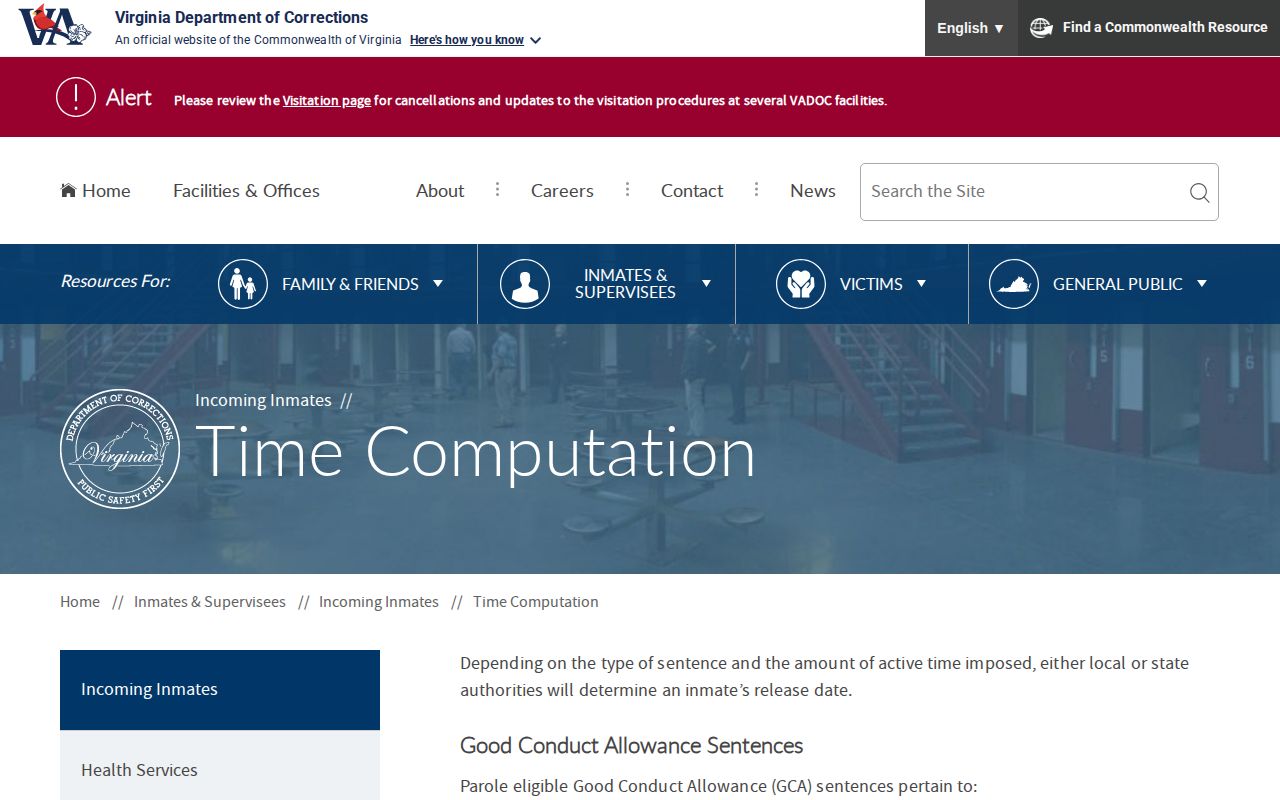
The image connects the public date lookup to VADOC's explanation of credit class, sentence type, jail credit, and later computation events.
Halifax Earned Release-Date Credits
Virginia's modern felony framework is often summarized as “truth in sentencing” or about 85 percent. That shorthand is not a safe personal calculator. Under the basic ESC-1 track, the maximum rate of 4.5 days of credit per 30 days served produces the familiar estimate when maximum credit is earned throughout. Section 53.1-202.2 defines the earned-credit framework, while section 53.1-202.3 addresses rates and offense eligibility.
ESC-2 differs. Eligible offenses under section 53.1-202.3(B) can earn from zero to 15 days per 30 served based on class, but the statute contains a long list of excluded offenses. Mandatory minimums, offense dates, and sentence combinations may limit application. Section 53.1-202.4 governs how credits apply. No one should assume that every Virginia prisoner serves either 65 percent or 85 percent.
Good Conduct Allowance generally concerns parole-eligible older felony cases and certain older misdemeanors. VADOC states that GCA can range from zero to 30 days per 30 served according to class. Most felonies committed on or after January 1, 1995 fall under the parole-abolition rule, subject to exceptions. The offense date, not merely the judgment date, is vital.
- Active time
- The confinement portion actually ordered after suspended time is separated.
- Jail credit
- Qualifying time already spent in custody before the state calculation.
- Concurrent terms
- Terms ordered to run at the same time, subject to the judgment.
- Consecutive terms
- Terms ordered to run one after another.
- Mandatory minimum
- A portion that credit rules cannot reduce unless law permits.
Why Halifax Release Dates Change
The official date is recalculated when a relevant input changes. A court can amend a sentence. VADOC can apply newly verified prior-custody credit. A person's credit class can improve or decline. Discipline may cause credit loss, and some credit may later be restored under applicable rules. Sentence terms may also be clarified as concurrent or consecutive.
| Factor | Possible effect | Best source |
|---|---|---|
| Prior jail credit | Moves the calculation when qualifying time is verified | VADOC computation and jail/court records |
| Credit class or discipline | Changes the rate or causes loss/restoration | Responsible correctional authority |
| Court order | Changes active time or sentence structure | Sentencing court and updated computation |
| Concurrent or consecutive terms | Changes how multiple terms combine | Judgments and VADOC computation |
| Parole action | May authorize conditional release for an eligible case | Virginia Parole Board and VADOC |
| Detainer or hold | May change the destination without changing sentence end | Custodian and holding agency |
A parole grant does not establish same-day release. VADOC must complete planning, read and sign the conditions, and resolve detainers. Likewise, the loss of a parole application does not explain every release-date change. Read the Board decision and the state computation as different records.
VADOC has limited authority under section 53.1-28 to set discharge within 30 days before normal expiration for prerelease programming. That is not a general right to early release and should not be added to a personal estimate.
Note: A detainer may change the release destination without changing the sentence end date shown by the correctional authority.
When Halifax State Release Occurs
For VADOC facilities such as Halifax Correctional Unit, the facility-release process says release is completed by 11:59 p.m. on the release date, weather permitting. This is a deadline, not a pickup appointment. Staff read the Order of Release, Conditions of Probation, or Conditions of Parole, and the released person and witness sign and date the document.
Property staff return personal items and collect state clothing. The business office returns offender-pay funds and, unless a detainer applies, adds enough to reach $25 when the balance is lower. Bus transportation may be arranged when needed. Medical staff may supply up to 30 days of medicine and needed supplies. These are VADOC practices and must not be presented as BRRJA rules.
A detainer can make the listed release date look misleading to someone waiting at home. ICE, another state, a court, or another authority may take custody when the VADOC term ends. ICE describes a detainer as a request for notice and custody for up to 48 hours beyond the time the person otherwise would be released so ICE can assume custody. In that event, the person left VADOC but was transferred, not freed.
The signed release letter or order, VADOC status, and receiving-custodian record should agree before the event is described as community release. Transportation planning alone never proves that no hold intervened.
Confirm a Halifax Projected Release
Check the source again near the date. Record the retrieval date because the value can change. VADOC Victim Services may send an anticipated-release notice about 30 days ahead and a new notice if the date changes. Actual release is a separate notification. For state custody, use NAAVI; local Virginia Jail VINE does not automatically cover VADOC.
Identity must be settled before any date is copied. The live VADOC search accepts a seven-digit DOC ID or a name route that uses at least the first three letters of the first name with the complete last name. Location, race, gender, and age-range filters can narrow similar results. Open the full record, confirm the person and facility, and preserve the interface's exact date label. If the person is now assigned to a supervision district, that status can show release from prison to community supervision rather than final discharge.
A Halifax pretrial detainee often has no sentence-based projected date at all. The next event depends on a bond decision, court order, dismissal, plea, trial, or other case action. In that setting, the Halifax court docket and BRRJA operational record are the proper sources. Applying a VADOC earned-credit formula to an unsentenced local detainee would produce a date with no official basis.
For an HCADC sentence, contact BRRJA and obtain the jail release or transfer entry after processing. For a state sentence, use the VADOC locator, release letter, and the computation office if needed. For a court-controlled pretrial release, read the bond or release order, then confirm the jail event. The Halifax County VINELink inmate search explains the notification split between the regional jail and VADOC.
Never treat disappearance from a current roster as a date result. The person may have transferred, the name may be entered differently, or the public interface may suppress old entries. An official release or transfer record identifies the event and, when recorded, the destination.
These checks also separate Halifax County custody from federal or immigration custody. BOP and ICE use their own locators. A local release date means only the BRRJA episode ended unless the destination confirms community release.