
Halifax Probation and Parole Compared
Parole and probation can both follow a person into the community, but they begin in different ways. The Virginia Parole Board decides discretionary parole for the limited population that remains eligible. Parole means the person serves an eligible part of a prison term in the community under conditions. VADOC Community Corrections then supervises the person. A Board decision and day-to-day supervision are held by different agencies.
Probation is imposed by a court. It may replace active confinement or follow time in jail or prison. Halifax County also has local Community Corrections and pretrial services. Local probation enforces a local court order, while pretrial supervision occurs before the case is decided. Neither should be labeled state parole. The order and case history determine which type applies.
| Type | Who starts it | Public confirmation |
|---|---|---|
| State parole | Virginia Parole Board for an eligible sentence | Board decision, VADOC locator, release order |
| State probation | Circuit court sentence or order | Court record, VADOC locator, assigned district |
| Local probation | Local court order | Court docket and Halifax local office |
| Pretrial supervision | Pretrial release order | Court record and local pretrial office |
- Parole
- Community service of the balance of an eligible prison sentence after Board action.
- Probation
- Court-ordered supervision instead of or after confinement.
- Discharge
- The formal end of the supervision term at issue.
- Absconder
- An agency or court status for a supervisee alleged to have stopped reporting or evaded supervision.
Check Halifax Post-Release Supervision
The VADOC Inmate and Supervisee Locator is the public starting point for a state case. Its name matters. Someone who no longer lives in a prison may still appear because VADOC supervises that person. Use a VADOC number when known. A name search needs care because two people can share a name. Open the full result, compare all public identifiers, and read the status and location together.
- Decide whether the release came from the BRRJA Halifax jail, Halifax Correctional Unit, or another custodian.
- Search the VADOC locator by VADOC number or legal name, then confirm the correct identity.
- If the result shows community supervision, use the current VADOC office directory to identify the assigned district.
- Read the Halifax court docket for probation, suspended time, later revocation, or discharge orders.
- For parole, check the Board's published decision record, then confirm the later release or supervision status through VADOC.
A no-result is not proof that supervision ended. The locator is not a complete archive of every past discharge. Ask VADOC for the specific historical record, or obtain the final court order when the public result is missing. For the full county jail release and transfer path, use the Halifax County released-inmate search.
Important: A Board parole grant is a decision, not the prison gate date. Release planning, conditions, and any detainer must be resolved first.
Halifax Supervision Offices Differ
South Boston District 8 is the documented VADOC state supervision office serving Halifax, Lunenburg, and Mecklenburg Counties and the Town of South Boston. The assigned district may still follow approved residence or case assignment, not the place of conviction. Verify it in the VADOC facilities and offices directory. Staff may confirm public routing but need not disclose confidential case notes.
VADOC South Boston District 82510 Houghton Avenue
South Boston, VA 24592
434-575-5774
Halifax County's Local Probation & Pretrial Services office is separate. It covers local Community Corrections orders and pretrial work, not Virginia Parole Board decisions or all VADOC probation cases. No public person-search is documented for this local office. The case docket is the right first record for deciding whether its role applies.
Halifax County Local Probation & Pretrial Services129 South Main Street
Halifax, VA 24558
Mail: P.O. Box 699
434-476-1183
That local-versus-state split is central to Halifax County probation and parole research. Calling the wrong office can produce a truthful response that the person is not in its system, yet say nothing about another form of supervision.
Note: Supervision assignment can follow the approved residence or case assignment, so it should not be guessed from the conviction county.
Halifax Parole Decisions and Meetings
Virginia ended discretionary parole for most felony offenses committed on or after January 1, 1995. Virginia Code § 53.1-165.1 states the general abolition rule, subject to limited exceptions. Older eligible sentences, some youthful-offender matters, geriatric conditional release, and other statutory categories require case-specific review. A conviction date alone is not enough. Offense date, sentence terms, prior commitments, and statutory exclusions can matter.
The Board's real public-meetings page lists events, agendas, streams when available, and past minutes. Its dates are irregular, so it should not be described as a weekly or monthly Halifax hearing calendar. Since July 2024, final grant deliberation and voting occur in a public meeting with victim participation, but not every eligible person's review appears as a public meeting event.
The monthly parole reports archive answers a different question. Reports may list a VADOC number, name, case type, dates, decision, reasons, offense and sentence information, jurisdiction, and Board votes. Search by surname or VADOC number and read the complete entry. Actions can include Grant, Not Grant, Continue on Parole, and Discharge.
Eligibility rules for older cases also resist a quick formula. Under Virginia Code § 53.1-151, the service fraction can depend on prior commitments, while life sentences and specified offenses have separate limits or exclusions. The Board process may include file review, an interview, input from interested parties, and a recorded action. That process determines parole action for an eligible sentence. It does not calculate ordinary probation or assign the later supervising district.
The archive view below comes from the Board's official parole reports source.
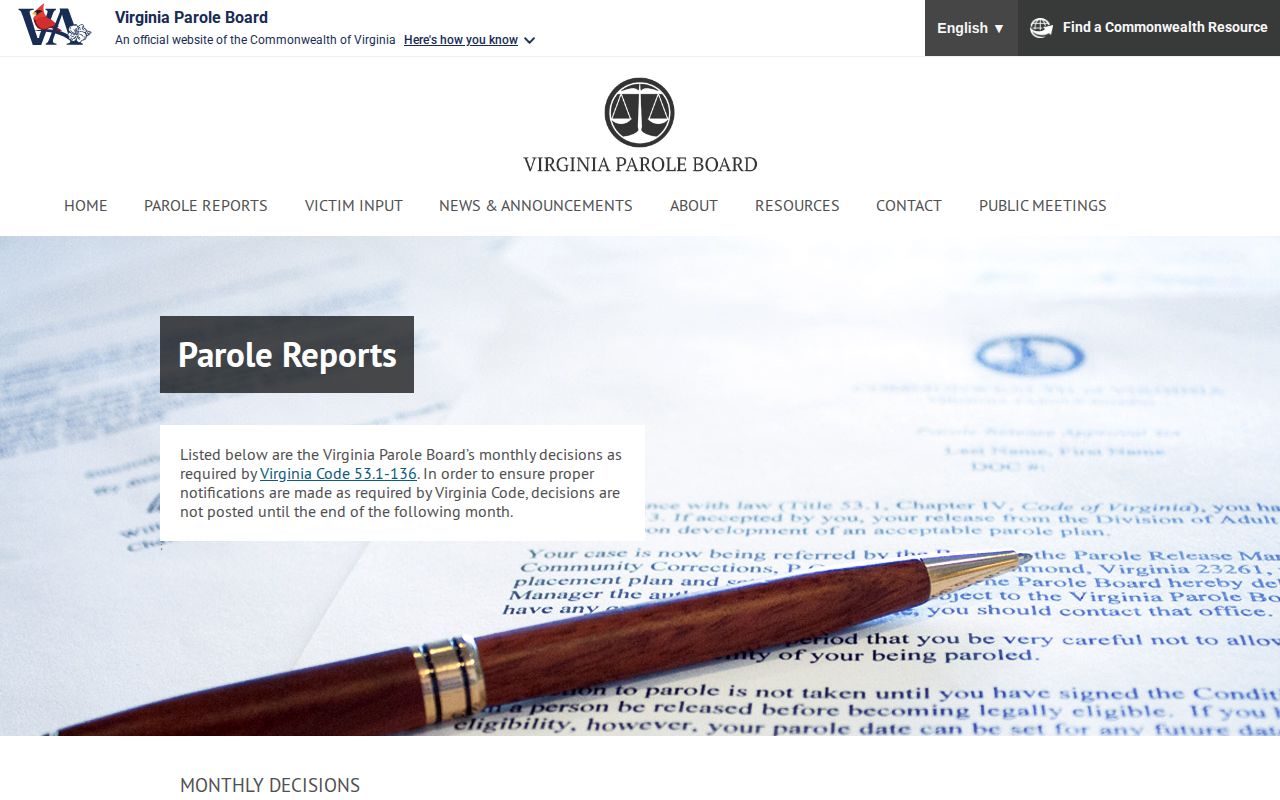
The image illustrates where monthly public decisions are organized, while VADOC remains the source for later custody or supervision status.
Halifax Violations and Absconder Status
Conditions may require reporting, an approved residence, lawful conduct, treatment, travel permission, or other duties set by the controlling order. The precise conditions belong in the signed probation or parole document. A violation allegation can lead to agency action, a warrant, a court hearing, or Board review. It does not by itself prove that the person returned to custody.
Halifax County has no verified public list of all absconders. VADOC's most-wanted page is selective, not a full supervision database. Absence from it cannot establish compliance or discharge. Likewise, a missed call or an old address does not establish a warrant. Use an official warrant channel for a known warrant or urgent safety matter. For routine verification, use the VADOC locator, assigned district, and court record.
Virginia FOIA protects parts of probation and parole supervision files. Public records may establish the court order, Board result, broad status, and office route without revealing private reports or case notes. Ask for a named existing record instead of a full confidential file.
Note: A transfer alert, revocation action, and new jail booking are distinct events and should be checked in the system that recorded each one.
Halifax Release Documents and Identification
Release from Halifax Correctional Unit follows VADOC's state-facility process. Staff read the applicable Order of Release, Conditions of Probation, or Conditions of Parole. The released person and a witness sign and date the document. Those papers can be stronger personal proof of post-release terms than a public locator result alone.
VADOC also documents return of personal property and offender-pay funds. Clothing may be supplied when needed. Medical staff may provide discharge medicine and supplies, and the published process addresses advance requests for medical records. Virginia Code § 53.1-31.4 provides an identification-document process for qualifying prisoners held at least 90 days who lack those documents.
These details apply to VADOC facility release. They are not proof of BRRJA policy at the Halifax County Adult Detention Center. A person released from the regional jail should request the BRRJA release entry and follow the court order. This local distinction prevents state-prison procedures from being attached to a county jail release.
When Halifax Supervision Ends
Leaving custody starts supervision in many cases. It does not end it. A parolee remains under parole conditions until discharge or another controlling event. A person on probation remains subject to the court's term and any VADOC or local supervision until the term ends or the court changes it. A suspended sentence can also remain important if a later violation is alleged.
Confirm the endpoint through the record that controls it. For probation, seek the sentencing order, later modification, revocation history, and final discharge or completion entry. For parole, compare the Board's action with the VADOC supervision record and any release documents. A monthly Board report can show “Discharge,” but identity and case type still must be checked.
A final supervision record should be distinguished from the release record that began the community term. The first can show when legal oversight ended. The second shows when facility custody ended and which conditions applied. Keeping both dates prevents a prison release from being mistaken for a full discharge years or months later.
Virginia Jail VINE is meant for local jail custody events, not ongoing state probation case management. VADOC's NAAVI service handles state-custody notifications and is also not a supervision-file search. Once those boundaries are clear, Halifax County probation and parole status can be verified without treating a custody alert as the final legal record.