
Halifax VINELink Release Coverage
Virginia Jail VINE through VINELink receives custody data from participating local jails. For Halifax County, the relevant local facility is the Halifax County Adult Detention Center, operated by the Blue Ridge Regional Jail Authority. VINE can help track a specific BRRJA custody episode. It is a notification service, not the jail's certified archive and not a list of everyone released in Halifax County.
The reporting agency supplies the event. A record may show custody information or an event described as release or transfer. Read the agency and event text closely. If BRRJA sends an event because a person moved to Halifax Correctional Unit or another VADOC facility, the person left local custody but did not enter the community. The BRRJA release or transfer entry and the court record give stronger historical context.
VINELink is also not the broad state-prison notification route. VADOC now directs state-custody notification registrations to NAAVI. A registration with local Virginia Jail VINE does not follow a person automatically into that state service. This two-layer structure is the key Halifax County VINELink limit.
Nor does local VINE replace a court search. Halifax General District Court commonly holds misdemeanor matters and felony preliminary events. Halifax Circuit Court holds felony judgments, district-court appeals, and later proceedings within its jurisdiction. A court order may explain bond, time served, dismissal, sentence, or probation. It usually does not prove the exact time that BRRJA staff completed a physical release, so the court and custody event should be read together.
| Custody episode | Notification route | What to confirm |
|---|---|---|
| HCADC or participating local jail | Virginia Jail VINE | BRRJA custody event and release/transfer entry |
| Halifax Correctional Unit or other VADOC site | VADOC NAAVI | VADOC locator, notice, and release record |
| Federal BOP custody | Not Virginia Jail VINE | BOP locator and federal case record |
| ICE custody | Not Virginia Jail VINE | ICE locator and official case channel |
Search a Halifax Inmate on VINELink
Begin with enough identity detail to avoid a false match. A full legal name is useful, while an identifier supported by the live form is more precise. Search the Virginia service, not a similarly named county system from another state. Open the record rather than relying on a brief search-result line. Confirm the facility or reporting agency before acting on the status.
- Open the official Virginia VINELink landing page and choose the offender or custody search.
- Enter the full name or identifier accepted by the current form.
- Use available identifying details to narrow multiple results without assuming the first name match is correct.
- Open the matching record and confirm BRRJA, HCADC, or the expected reporting custodian.
- Read the status and most recent event together, then save the agency contact needed for confirmation.
A no-result has several possible meanings. The name may differ, data may lag, the record may no longer be in public scope, or the person may be held by another custodian. Check the official HCADC page for the current-inmate inquiry, then call HCADC or request the BRRJA release/transfer entry. The complete named-person fallback appears on the Halifax County released-inmate search.
When calling HCADC, ask a narrow current-status question and verify the spelling or booking identifier. For a lasting record, contact BRRJA's FOIA office instead of assuming front-desk staff can produce a copy at once. A focused request should name the person, Halifax facility, and date range, then ask separately for the release or transfer date, category, authority, and destination if recorded. Requesting an electronic copy and an advance cost estimate keeps the scope clear.
Note: Roster absence and a VINELink no-result do not establish release; both require an agency record or another confirmed custody destination.
Halifax VINELink Release Fields
The exact live fields can change. Preserve the labels shown on the record and avoid renaming them. A local event reports what that source system transmitted. It does not decide the criminal case, prove the person reached the community, or replace the jail ledger.
| Field or item | How to read it |
|---|---|
| Name or offender identifier | Use it to verify the correct person; do not rely on name alone. |
| Reporting agency or facility | Shows which custodian supplied the event. |
| Custody status | Describes the source agency's current reported state, subject to lag. |
| Release or transfer event | Shows a change in that custody episode, not always community freedom. |
| Notification choices | Lists channels and events offered by the current interface. |
For a legal outcome, use the Virginia court case record. It may show bond, dismissal, time served, a sentence, probation, or later revocation. The docket can explain authority for release, yet it usually does not certify the minute the jail completed its process. BRRJA owns the local jail entry.
Important: A VINE alert is timely notice, not a certified release record. Confirm the event, destination, and continuing custody with the reporting agency.
Register for Halifax Release Alerts
Registration begins on the correct person's record. Choose the custody events and contact methods the current interface offers. Virginia materials support phone and email options, with other channels available in current VINE materials. Follow the live screen because options can change. Registration is free and confidential, but it does not create a right to advance notice in every circumstance.
- Select the registration or notification option on the verified record.
- Choose the release, transfer, or custody-change events needed for that person.
- Enter the offered phone number or email destination accurately.
- Create the requested telephone PIN for automated calls.
- Complete any email or on-screen confirmation, then keep the registration details private.
The telephone PIN acknowledges the call and stops repeated calls. Do not assume that the same PIN rule applies to email or text unless the current interface says so. If the message is missed or unclear, search again and contact the reporting jail. An alert can arrive after the actual movement because source updates and delivery take time.
Keep registration details private. A phone number, email address, and PIN are delivery credentials, not public record fields. If a contact method changes, update or replace the registration through the official system. Registering twice through the same local service does not create state coverage, and registering with NAAVI does not recreate a closed BRRJA custody episode.
The official VADOC notification page below explains the program that applies after a person enters state custody.
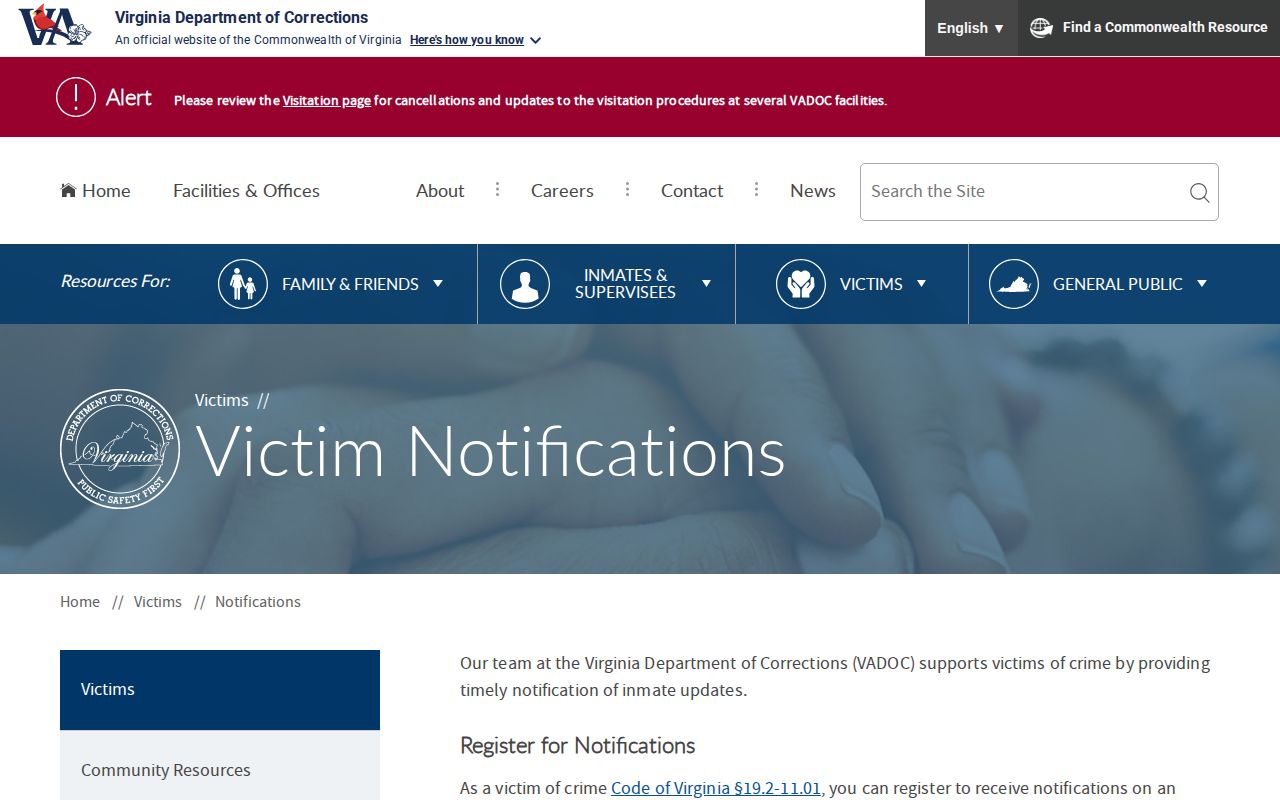
The state page helps distinguish NAAVI registration from the separate Halifax local-jail VINELink record.
Halifax VINE and NAAVI Transfers
VADOC Victim Notifications expressly separates NAAVI from local-jail VINE. VADOC notifications may cover transfers, an anticipated release, a changed anticipated date, and actual release. Advance release notice is typically sent about 30 days before the anticipated date, while actual release is a later event. Notifications stop after release.
A Halifax transfer can cross this system boundary. Suppose BRRJA reports that a person left HCADC and VADOC later receives that person. The local notification may look like an end to jail custody, while the VADOC locator shows a new state location. A new NAAVI registration is needed for state events. The two records describe consecutive custody episodes, not conflicting facts.
For registration help, VADOC Victim Services lists 1-800-560-4292. The service is for state-custody notification. It should not be used to ask VADOC to certify a purely local HCADC release. Conversely, BRRJA cannot interpret a VADOC sentence computation or state release date.
State notifications also use careful date language. VADOC describes an “anticipated release date” notice and sends a new notice when that date changes. Actual release is reported later. A projected date can move because of credit, a court order, discipline, sentence structure, or a detainer. An advance message should therefore guide preparation, not be treated as proof that the final custody event already occurred.
Note: A transfer from HCADC to VADOC requires a new state notification registration because local VINE and NAAVI are separate systems.
Confirm Halifax VINELink Release Events
Three checks make a local alert more useful. First, verify the agency named in the message. Second, ask whether the event was community release or transfer to another custodian. Third, match the event with the court disposition or jail release entry. This prevents a custody handoff from being described as freedom.
Federal custody is outside the Halifax County VINELink inmate search. The BOP Inmate Locator may show a historical federal result as released with a date. A person in U.S. Marshals custody may not yet appear in BOP, so the federal docket and official district channels are needed. Immigration custody uses the ICE Online Detainee Locator, which is a current-custody tool rather than a release archive.
The Virginia State Police registry is also separate. It includes only people with a statutory registration duty and is not a general directory of released people. Absence from it has no bearing on an ordinary Halifax jail release. Use each tool only for the event and population it was built to cover.
A notification can also end before a historical question is settled. VADOC says state notices stop after actual release, while the jail release entry and court disposition remain the better archival sources. Save the agency name and event details from a lawful alert, then request the underlying record when the date, category, or destination must be confirmed later.
Finally, ask BRRJA for an existing release or transfer entry when lasting proof is needed. A focused request can identify the person, facility, and date range, then ask for the release date and time, category or authority, and destination custodian if recorded. That record can confirm what the VINE message began.