
Halifax 72-Hour Release Reality
The Blue Ridge Regional Jail Authority operates Halifax County Adult Detention Center. Its official Halifax page links to a tool labeled “Locate HCADC Inmates,” which defines the product as a current inquiry. No BRRJA page or vendor control was verified as a rolling 72-hour release list. No public feed cadence, retention limit, release fields, or released-person photo policy was found.
A three-day result must be built from existing records rather than inferred from the live roster. Give BRRJA a fixed start and end timestamp in Eastern Time and ask for release or transfer entries within that span. If staff maintain an export, request that existing file in electronic form. If they do not, Virginia FOIA does not require creation of a new spreadsheet merely to satisfy the request.
Request Halifax Three-Day Release Records
Start with the event window, not a loose phrase such as “the weekend.” State both dates, both times, the time zone, and HCADC as the facility. For a list request, ask for existing booking or release-log entries during that interval. For one person, add the full name and any known booking identifier. Ask BRRJA to include release time, release category or authority, and destination custodian if those fields exist.
- Choose the exact 72-hour opening and closing timestamps. Preserve them in the request so the result can be checked later.
- Use the BRRJA FOIA form, email foiarequest@brrja.state.va.us, or contact the FOIA officer at 434-847-3100 ext. 1224.
- Ask whether an existing electronic release export covers the interval. Request an advance, itemized cost estimate before search or copy work begins.
- For a specific person, check Virginia Jail VINE for the custody event and match the agency and identity.
- Read the related case in the Virginia Judicial System portal. A court order explains legal action but may not show the exact gate time.
Call HCADC at 434-476-5500 for current operational confirmation. Do not expect lobby staff to create a historical report while a requester waits. Stored records belong with the records custodian. A request can be narrowed if the first estimate is high, which is especially useful because a three-day search may require more staff time than a single-person lookup.
Halifax 72-Hour Release Fields
The fields below come from the Halifax research inventory as suitable record items to request. They are not advertised columns in a public BRRJA feed. A response can vary by the jail-management entry, the facts of the custody episode, and lawful redactions. Each field should be tied to one verified identity before conclusions are drawn.
| Record item | Use within the three-day check |
|---|---|
| Name and booking identifier | Connects the entry to the intended person and regional-jail episode. |
| Booking date and time | Shows when the HCADC custody episode began. |
| Holding charge or authority | Identifies why the jail held the person, subject to record limits. |
| Release or transfer timestamp | Tests whether the event falls inside the exact 72-hour interval. |
| Release code or authority | May identify bond, recognizance, court order, time served, sentence completion, or transfer. |
| Destination | Can show whether custody continued with VADOC, another jail, federal authorities, or ICE. |
Virginia’s law-enforcement-record provisions can affect access and redaction. The image below documents the statute that must be read with the general FOIA response rules.
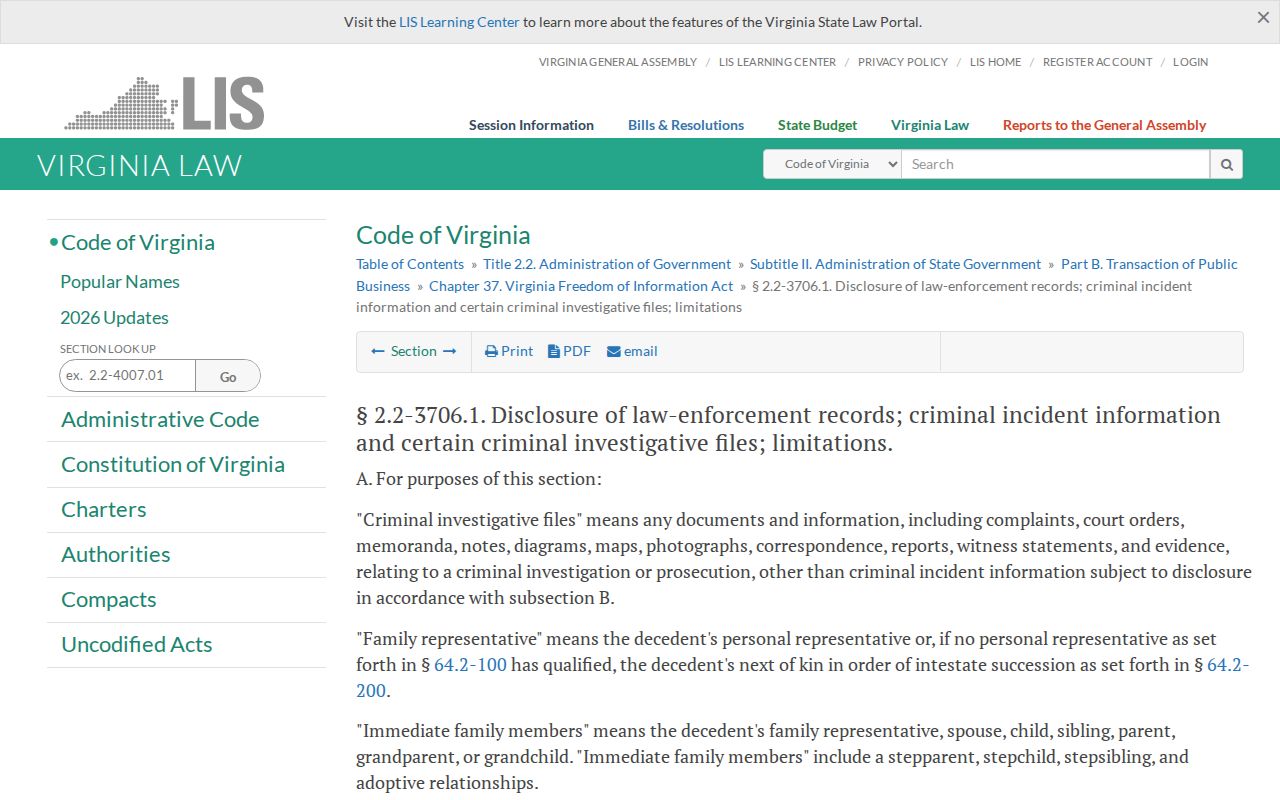
A denial or redaction should identify the applicable record category and legal basis. Public bodies may release nonexempt portions while withholding protected material.
Note: The underlying record may outlast the public roster entry, so request the stored release or transfer record instead of assuming online retention.
Read Halifax Release Evidence
Each Halifax source proves a limited fact. The live BRRJA inquiry can show that the authority currently displays a person in its Halifax data, subject to identity checks and lag. It cannot establish a three-day history. A BRRJA release entry can establish the date, time, and category recorded by the jail and may identify a transfer destination. It does not prove that every linked charge ended.
The court disposition records legal action. Bond, dismissal, sentence, suspended time, time served, probation, and revocation each have distinct meanings. A court order may authorize release without showing when jail staff finished processing. One case also may not reveal a hold in another matter. Match court, case number, defendant, charge, disposition date, sentence, and later revocation activity before drawing a conclusion. Confirm the local court through the Halifax General District Court page.
A Virginia Jail VINE event confirms that the participating source system sent a custody update. It is not a certified historical record, and a release-style alert can be followed by custody under another authority. For a state transfer, the VADOC locator provides public custody or supervision information within its current scope. For a federal transfer, the BOP locator or federal case is the better route. ICE’s locator concerns immigration custody, not a Halifax release archive.
Three records that converge are stronger than one screen: BRRJA’s custody entry, the court action, and a notification or current destination record. Keep the retrieval date with each result. Dynamic systems change, while a stored request response or certified court copy provides a more stable record of what was returned.
Weekend Halifax Release Timing
A 72-hour range is most useful as a records boundary. It can bridge Friday-to-Monday uncertainty or cover a period when the requester learned about an event after it happened. Research did not establish that HCADC batches weekend releases, delays them to business hours, or publishes a holiday schedule. Those details must not be inferred from the lack of an online feed.
Court action and physical release also occur on different clocks. A bond order, dismissal, or time-served ruling can authorize release, while jail staff still must clear other holds, confirm identity, and complete custody processing. Conversely, the court docket may preserve the legal result long after the current roster changes. Use the court for legal cause and BRRJA for the physical custody entry.
The same distinction applies to a state transfer. Movement from HCADC to Halifax Correctional Unit or another VADOC institution is not release into the community. Search the VADOC locator when the destination points to state custody. If the person moved to federal or immigration custody, use the federal case and appropriate locator rather than treating the end of the Halifax episode as freedom.
Why Halifax Roster Absence Misleads
Halifax has a local data problem. BRRJA deliberately labels the tool as a way to locate HCADC inmates. The vendor inquiry has no verified released, 24-hour, or 72-hour filter. A disappearance from that tool therefore cannot be recycled into a three-day release result.
The safe finding is simply “not returned by the current inquiry.” Transfer, spelling differences, excluded records, delayed transmission, and another custodian can all lead to the same screen result. The correct local product is the BRRJA release or transfer record, checked against VINE and the court. That three-source approach distinguishes an administrative custody change from the legal result of the case.
The official HCADC source page identifies the inquiry’s current-custody purpose. BRRJA’s FOIA route identifies the custodian for the historical record. Neither source promises that a former detainee stays visible online for three days, and no safe retention period was found.
Verify Halifax Three-Day Releases
Virginia Code § 53.1-116 requires local jailers to maintain commitment and prisoner records and a written earned-credit policy. The capture below provides the statute source for that records context.
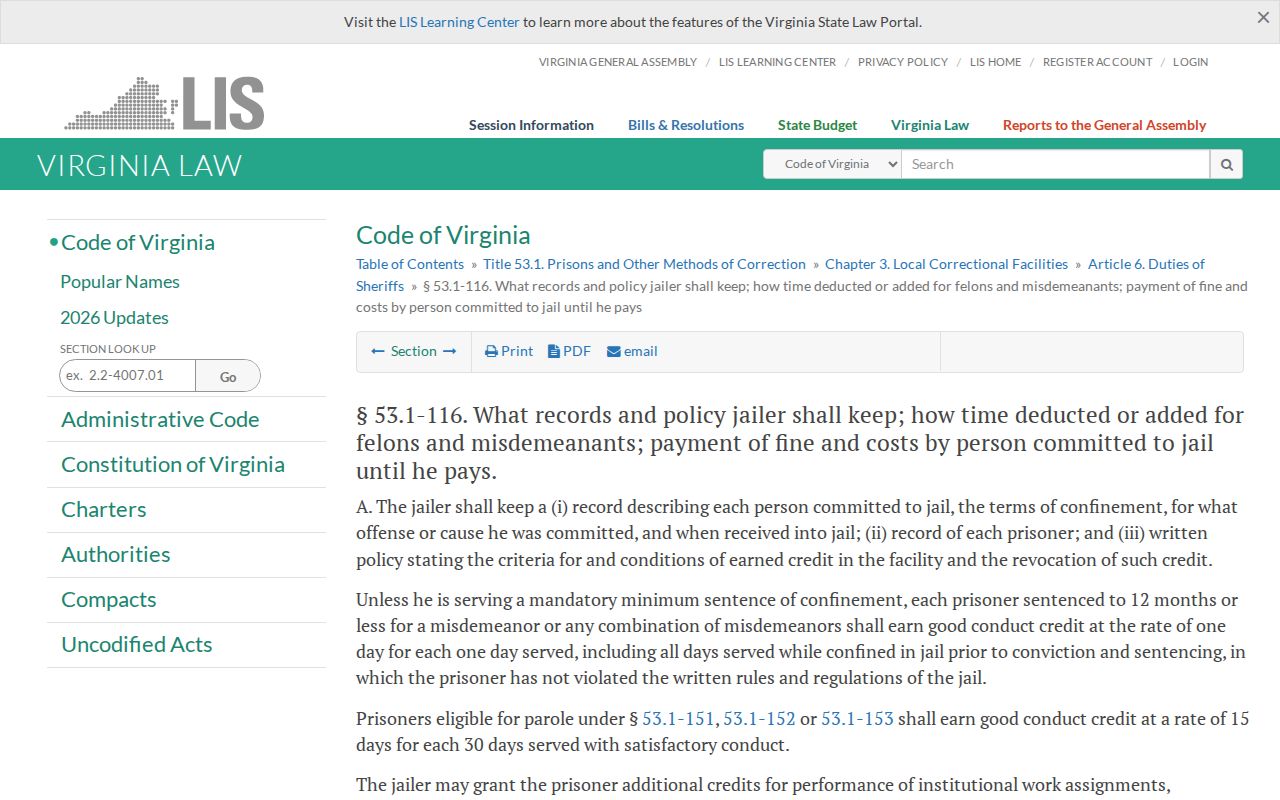
The law supports asking for the stored entry but does not make each jail-management field unconditionally public. FOIA exemptions, sealed records, juvenile confidentiality, security needs, and privacy protections can limit the result. Ask for a written response and the cited basis for any withheld part.
A release category also needs plain-language context. Bond ends detention while the charge may remain pending. Time served addresses custody ordered in the case, but another hold may exist. A transfer means custody continued. Parole ends prison confinement under conditions, while discharge generally ends the relevant state term. Read all linked events before stating that someone reached the community.
The Halifax County 24-hour release route fits a known same-day period. For an uncertain name or older date, use the Halifax County released-inmate record path, which checks local, state, court, notification, federal, and immigration sources by custody class.
Note: A three-day request is a historical records task; the live HCADC line is best reserved for present operational confirmation.